What Is Megapixels in Camera and Why It Matters
Published: 3 Mar 2026
When you’re shopping for a new camera or smartphone, you’ve probably come across the term “megapixels.” It’s one of the most common selling points, but do you know what it really means and how it affects your photos?
In this article, we’ll explain everything you need to know about megapixels, from what they are to how many you need for outstanding photos. So, let’s dive in.
What is a Megapixel?
Simply put, a megapixel (MP) is a unit used to measure the resolution of a digital image. The term comes from “mega,” meaning million, and “pixel,” which refers to the smallest unit of an image. So, one megapixel equals one million pixels.
To understand it better, imagine a pixel as a tiny square of color. Each pixel contributes a small part to the overall picture. When millions of these tiny colored squares come together, they form the photo you see on your camera or phone. So, more megapixels mean more pixels, which results in a higher-resolution image.
When you take a photo, your camera captures all these individual pixels, and together, they create a full image. If you zoom in really close, you’ll notice the image starts to look like a grid of tiny colored squares. But when you zoom out, those pixels merge together to form a smooth, sharp photograph.
How Do Megapixels Affect Image Quality?
Megapixels play a big role in image resolution, but they don’t tell the whole story. More megapixels can lead to sharper images with more detail, especially when you zoom in or crop photos. For example, a 48MP camera can give you more detail than a 12MP camera, which is great if you want to make large prints or need to crop an image without losing quality.
However, it’s important to remember that megapixels alone don’t determine the quality of your photos. The sensor size, lens quality, and image processing also have a significant impact on how good your photo looks. For example, a 16MP camera with a larger sensor may give you better results than a 48MP camera with a smaller sensor, especially in low-light conditions.
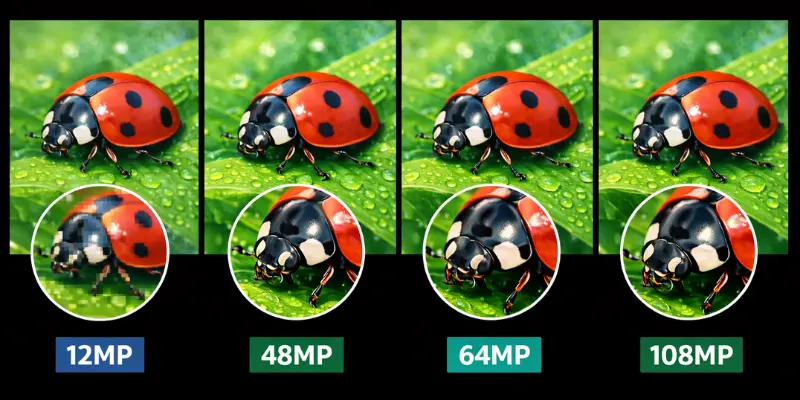
In short, while higher megapixels are useful for getting more detail and sharper images, factors like sensor quality and lens performance also play a huge role in the overall image quality.
How Many Megapixels Do You Actually Need?
When shopping for a camera, you might wonder: How many megapixels do I need? The answer depends on your needs and how you plan to use your photos. Let’s break it down to help you choose the right megapixel count.
- For everyday photography (family photos, vacations, social media): 12MP to 16MP is more than enough. In fact, most modern smartphones have 12MP cameras, and they do a great job for casual use.
- For professional photography (landscapes, portraits, events): 20MP or more is usually preferred. Higher megapixels give you more flexibility when editing or cropping your images.
- For large prints or detailed artwork: 40MP or higher is ideal. If you plan to print your photos as posters or do heavy cropping, more megapixels will keep the image sharp and clear.
Common Misconceptions About Megapixels
While megapixels are important, there are several common myths that can mislead you when choosing a camera. Let’s clear up some of the most common misconceptions:
1. More Megapixels Always Mean Better Photo Quality
This is one of the biggest myths! While more megapixels can capture more detail, they don’t automatically result in better image quality. The sensor size, lens quality, and image processing play a much bigger role in the clarity and vibrancy of your photos.
2. Higher Megapixels Are Better for Low-Light Photos
More megapixels won’t necessarily improve your photos in low-light situations. In fact, larger sensors that capture more light are much more important in low-light photography than megapixels. Cameras with larger sensors (even at lower megapixels) can produce much better results in darker conditions because they capture more light per pixel.
3. More Megapixels Mean Faster Shutter Speeds
Higher megapixels do not make a camera’s shutter speed faster. In fact, cameras with more megapixels might take slightly longer to process each image due to the increased amount of data. Shutter speed is determined by the camera’s sensor speed, processing power, and overall performance, not just the number of megapixels.
Conclusion
To sum up, megapixels are important, but they shouldn’t be the only thing you focus on when choosing a camera. Depending on your needs, a 12MP camera might be more than enough for everyday use, while higher megapixels are better suited for professional or large-scale photography.
Remember, it’s not just about the number of megapixels; it’s about how the camera as a whole performs — including its sensor, lens, and processing power.
So next time you’re in the market for a new camera, think about your needs and how many megapixels will actually benefit your photography.
FAQs (Frequently Asked Questions)
Here are answers to some of the most common questions about megapixels:
Megapixels refer to the resolution of an image, while image quality depends on other factors like sensor size, lens quality, and processing power. More megapixels can give you sharper images, but they don’t guarantee better overall quality. A camera with a good sensor and lens can take great photos even with fewer megapixels.
A good camera usually has 12MP to 24MP for most users. This range is perfect for social media, family photos, and even medium-sized prints. Professional photographers may prefer 20MP or higher for more editing flexibility.
One megapixel equals one million pixels. For example, an image that is 1000 × 1000 pixels equals 1,000,000 pixels, which is 1MP. These tiny pixels come together to form a complete photo.
4K resolution is about 8.3 megapixels. A standard 4K image size is 3840 × 2160 pixels, which equals around 8 million pixels. Keep in mind that 4K usually refers to video resolution, not photo quality.
The highest resolution digital camera in the world is the LSST Camera. It has an incredible 3,200 megapixels (3.2 gigapixels). This camera was built for the Vera C. Rubin Observatory in Chile and is used to scan the Southern night sky for space research, not for normal photography.






- Be Respectful
- Stay Relevant
- Stay Positive
- True Feedback
- Encourage Discussion
- Avoid Spamming
- No Fake News
- Don't Copy-Paste
- No Personal Attacks
- Be Respectful
- Stay Relevant
- Stay Positive
- True Feedback
- Encourage Discussion
- Avoid Spamming
- No Fake News
- Don't Copy-Paste
- No Personal Attacks
